
How Do You Verify Marketing Consultant Results?

Quick Summary
You verify marketing consultant results by checking the raw data behind the report, not the report itself. That means account access, test enquiries, CRM records, and a baseline for comparison. A polished deck is not proof.
Pull the 90 days before the engagement as your baseline for judging change.
Recalculate cost per lead using raw ad platform spend divided by CRM lead counts.
Trace one real lead end to end from first touch to closed deal.
Compare at least three periods, because a single strong month can be noise.
Confirm you hold admin rights to your own analytics, ad accounts, and CRM.
Can you prove your marketing results?VivianOlodun helps owners build influence and verify real marketing outcomes.
How Do You Verify Marketing Consultant Results?
You verify marketing consultant results by checking the raw data behind the report, not the report itself. That means account access, test enquiries, CRM records, and a baseline for comparison. A polished deck is not proof.
The stakes are real. A consultant who cannot show you the inside of your own ad account is asking you to trust a story. You deserve better than that.
This guide gives you a repeatable way to check the work. You will get a 90-day workflow, a scorecard, and the exact questions to ask. Below, we show you how to separate a real result from a nice-looking number.
Marketing Consultant Performance Metrics That Prove Real Business Outcomes
Real outcomes show up in money and pipeline, not in applause. So start with the metrics a finance person would recognize.
Track these:
Qualified leads per month
Cost per lead
Customer acquisition cost
Lead-to-sale rate
Revenue attributed to campaign
Return on investment
These are your key performance indicators. They tie marketing spend to sales. For a deeper look at connecting marketing to revenue, see sales training.
Vanity Metrics vs. Revenue Metrics
Vanity metrics look good and prove little. Impressions, follower counts, and page views can rise while sales stay flat.
Revenue metrics answer a harder question: did the work make money? A jump in organic traffic means nothing if none of those visitors book a call. Ask for the path from click to closed deal.
Marketing Campaign Results Examples You Should Expect to See
Expect examples that name the channel, the spend, and the return. A real case study shows the starting point, the change, and the time frame.
Here is what a credible example looks like:
The channel, such as paid search or SEO
The ad spend or hours invested
The leads generated and how many were qualified
The sales that followed
The reporting period
If a consultant shows you past work, ask for project case studies that match your industry and budget. You can also watch Vivian's vlog to see how she talks through client outcomes. Vague wins like "great exposure" are a warning sign, not a result.
Questions to Ask a Marketing Consultant About Their Data
Ask how the numbers are gathered before you ask what they mean. The answer tells you whether the data is real.
Put these questions on your list:
Which accounts will I own and have admin access to?
How do you track leads from form to sale?
Where does conversion tracking live, and can I see it?
How do you report cost per lead and acquisition cost?
What was the baseline before you started?
Can I speak to a client reference?
A consultant with nothing to hide answers these without flinching. If you want to start that conversation directly, get in touch and ask away.
Marketing Consultant Reporting: What a Transparent Report Contains
A transparent report shows the source data behind every number. It does not just present totals. It lets you trace each figure back to the account it came from.
A good report includes:
The reporting period and the baseline it compares to
Channel-by-channel breakdowns
Lead counts and lead quality notes
Spend, cost per lead, and acquisition cost
A clear note on what could not be measured
Account Access, Ownership, and Auditability
You should own your accounts. Your Google Analytics, ad accounts, and CRM should sit under your login, with the consultant added as a user. This keeps the data auditable and yours if the relationship ends.
Watch out: if a consultant insists on holding admin rights to your accounts, you lose the ability to check the work and the ability to leave.
Attribution Limits: Why Results Are Harder to Prove Than They Look
Attribution is the process of linking a sale back to the marketing that caused it. It is rarely clean. A buyer may see an ad, read a review, then call a week later. That gap creates measurement uncertainty, and no dashboard solves it fully.
Several mechanisms routinely distort reported results. Understanding them lets you ask sharper questions.
Attribution windows. Platforms credit conversions within a set window, such as 7-day click or 1-day view. A sale that closes on day 10 may be invisible to the platform but real to your business. Ask what window the consultant uses and whether it matches your actual sales cycle.
Attribution models. Last-click, first-click, linear, and position-based models assign credit differently (Types of basic attribution models). A channel can look strong under one model and weak under another. Ask which model is used and whether the same model is applied consistently across periods.
Assisted conversions. A buyer may touch several channels before converting. Platforms often claim credit for the same sale, so totals can exceed actual revenue. Ask how the consultant de-duplicates cross-channel credit.
Offline and phone sales. Deals closed by phone, in person, or through a sales team may never enter the ad platform. If call tracking or CRM logging is incomplete, reported ROI understates or overstates performance.
Seasonality and external factors. A strong quarter may reflect market demand, a competitor's exit, or a seasonal spike rather than the consultant's work. Compare year-over-year where possible, not just month-over-month.
Client-side delays. Slow lead follow-up, unresponsive sales teams, or delayed CRM updates can suppress conversion rates that the consultant does not control.
A common pattern is for consultants to present platform-reported conversions as if they were closed revenue. Those are different numbers. Platform conversions measure actions; revenue measures money collected. Ask for the reconciliation between the two.
Treat attribution data as a strong signal, not a courtroom verdict. Honest consultants will tell you where the numbers are soft, which channels are over-credited, and what cannot be measured with current tracking. That honesty is worth more than a perfect-looking chart. If a consultant presents every number as exact, ask how they handle assisted conversions and offline sales.
A Step-by-Step Verification Workflow to Run Every 90 Days
Run this workflow each quarter. It takes a few hours and saves you from months of guesswork. The goal is not to catch a consultant in a lie, but to confirm that reported results can be reproduced from source data you control.

Marketing consultant and client reviewing performance results on a laptop and printed report at a sunny desk
Pull the baseline. Collect the 90 days before the engagement started: lead counts, cost per lead, conversion rates, and revenue. Without a baseline, you cannot judge change.
Log into your own analytics. Open Google Analytics, your ad platforms, and your CRM under your own login. Compare the reporting period to the baseline. If you cannot access an account, that is a finding in itself.
Send test enquiries. Submit a form, call the tracked number, and send an email. Confirm each test lead appears in the CRM within the expected time frame.
Trace one lead end to end. Pick a real lead from the period and follow it from first touch to closed deal. Note where the data is complete and where it breaks.
Recalculate cost per lead. Divide raw spend from the ad platform by lead counts from your CRM, not from the consultant's report. Compare the two figures.
Check lead quality, not just volume. Ask what percentage of leads were qualified and what the lead-to-sale rate was. A rising lead count with falling quality is not progress.
Run a trend analysis. Compare at least three periods, not two. A single strong month can be noise; a three-period trend is harder to fake.
Request evidence for any number you cannot reproduce. Ask for the source export, the date range, and the calculation method. A consultant who cannot provide these is asking you to trust a story.
Watch out: if a figure fails step five or eight, do not assume fraud. There may be a legitimate reason, such as a tracking change or a CRM migration. Ask for the explanation in writing and check whether it is consistent with the other data.
Channel-Specific Verification Checklist
Each channel needs its own check. Use this list:
SEO: confirm rankings and organic traffic in your own tools, and check that reported pages actually exist and are indexed
Paid search: open the ad account and review spend, conversions, and search term reports for irrelevant traffic
Social: match reported reach and engagement to the platform's own numbers, and check whether paid amplification is disclosed
Email: check open and click data in the sending platform, and confirm list growth sources
Referrals: confirm the source of each inbound lead in your CRM, not just in the consultant's summary
Content: verify that published assets are live, indexed, and linked as reported
This checklist turns a vague promise into something you can audit line by line. Keep the completed checklist and the source exports together so the next review starts from evidence rather than memory.
Marketing Consultant Performance Metrics That Prove Real Business Outcomes
You already have the metric list above. The job now is to put it on one page and score it.
Build a Scorecard That Holds Your Marketing Accountable
A scorecard turns trust into a monthly habit. Score each area on a simple scale, then review it with your consultant.
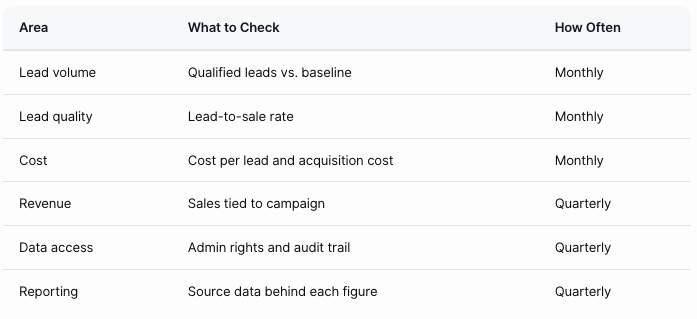
If you want a partner who expects this level of scrutiny, work with Vivian and build the scorecard together.
The hardest part of hiring a consultant is not finding one. It is knowing whether the work is real. Hold every claim to the data, run the 90-day workflow, and keep ownership of your accounts. VivianOlodun helps ambitious owners build influence and demand top dollar, with 22 years of marketing experience and a track record of raising $15 million for women in business. Get started with VivianOlodun and turn marketing results into numbers you can verify.
Frequently Asked Questions
How do you tell whether marketing results came from a consultant's work?
Compare the reporting period against a baseline captured before the engagement started. Look at trend lines rather than single-month spikes, and check whether leads, qualified leads, and closed sales moved together. Ask for the raw source data (Google Analytics, CRM records, call logs) so you can validate the numbers yourself. Attribution is never perfect, so treat any claim that ignores seasonality, prior campaigns, or organic traffic as incomplete.
What metrics should you use to evaluate a marketing consultant?
Track business-facing numbers: cost per lead, lead quality, conversion rate, customer acquisition cost, lead-to-sale rate, and return on investment. Pair those with supporting metrics like organic traffic, search rankings, and paid search performance. Skip vanity metrics such as impressions and follower counts unless they clearly tie to pipeline. A consultant who reports only reach and engagement without sales data is showing activity, not results.
What should you do if a marketing consultant cannot prove their results?
Request access to the underlying accounts and a written summary of deliverables completed against the agreed scope. If they cannot provide conversion tracking data, CRM records, or campaign evidence, treat that as a red flag. Set a short review window with specific performance targets. If nothing verifiable appears, end the engagement and keep ownership of your analytics, ad accounts, and domain so the next provider starts with clean data.
How often should you review a marketing consultant's performance?
Run a light monthly check on lead volume, spend, and reporting accuracy, then a deeper review every 90 days against your baseline. Give campaigns enough time to gather data before judging them, since short windows produce noisy results. At each review, compare trend analysis across periods and confirm the consultant still has the right access, tracking, and test enquiries in place.