
How to Build Authority as a Realtor Step by Step

Quick Summary
To build authority realtor status, publish useful content that answers buyer and seller questions, post market updates on a fixed schedule using verifiable local data, and build a professional presence on LinkedIn. Authority grows from showing consistent local knowledge over time.
Publish content that answers the questions clients asked you last month.
Build each market update from the same repeatable data set so numbers stay comparable.
Source every market number from your MLS export or local association statistics, and state the period.
Post one market update or content piece weekly on LinkedIn and respond to comments within a day.
Claim your Google Business Profile and ask every closed client for a review at peak satisfaction.
Ready to be seen as the local expert?VivianOlodun helps professionals build influence and strategic positioning in their market.
How do you build authority as a realtor?
Authority as a realtor comes from showing local knowledge consistently over time, so buyers and sellers see you as the person who understands their market. To build authority realtor status, publish useful content, post market updates on a fixed schedule, and build a professional presence on LinkedIn.
Authority grows slowly, then suddenly. Focus on being seen as the expert in the room, not just another agent with a listing.
Here are three steps you can start this week.
Step 1: Publish Real Estate Content Ideas for Agents That Answer Buyer Questions
Good real estate content answers the questions buyers and sellers ask before they call you. What clients asked you last month makes the best article topics.
Useful content ideas for agents include:
Buyer costs: what closing costs really include, and how to plan for them
Neighborhood guides: school zones, commute times, and what daily life feels like
Seller prep: which upgrades pay off and which ones do not
Process explainers: what happens between offer acceptance and closing day
A common mistake is writing about yourself instead of the reader. Your credibility grows when your content solves a real problem.
Step 2: Post Real Estate Market Update Examples on a Fixed Schedule
Consistency matters more than volume, but consistency without credible data just trains readers to ignore you. Pick one day each week or month, and build each update from the same repeatable data set so numbers stay comparable.

Realtor reviewing a neighborhood sales report on a laptop to build authority realtor status during a market update.
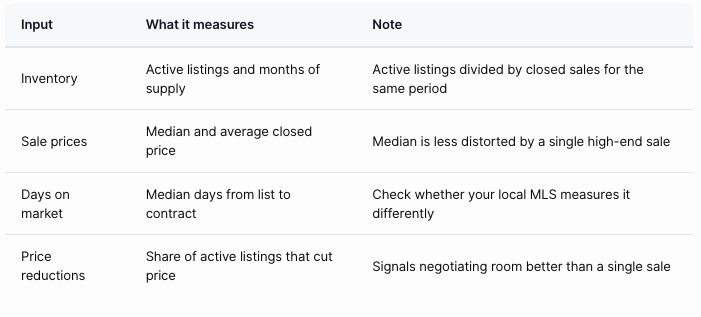
A defensible market update pulls from sources your audience can verify. These four inputs cover what buyers and sellers actually ask:
Inventory: active listings in your defined area, plus months of supply (active listings divided by closed sales for the same period)
Sale prices: median and average closed price, with the caveat that median is less distorted by a single high-end sale
Days on market: median days from list to contract, not list to close, and note whether your local MLS measures it differently
Price reductions: the share of active listings that have cut price, which signals negotiating room better than any single sale
Source each number from your MLS export or your local association of realtors' published statistics, and state the period and geography in one line at the top (for example, "Single-family closed sales, [your submarket], last 30 days versus prior 30 days"). If you cannot name the source and date range, do not publish the number.
Interpretation is where authority is won or lost. Write one sentence on what the data means for a buyer and one for a seller, and stop there. A single month of rising median price is not a trend, and a low inventory figure in a small submarket can swing on two or three sales. Use qualified language ("suggests," "on this sample") and say plainly when a sample is too small to conclude anything.
!A realtor reviewing a neighborhood sales report on a laptop at a bright home office desk with a notepad beside it
Keep updates short and plain, and avoid jargon. Over 30, 60, and 90 days, track two KPIs: updates published on schedule and replies, saves, or direct inquiries each one generates. That tells you which data points your local audience cares about.
Watch out: authority content creates advertising and fair housing exposure. Substantiate any claim about your results or the market, follow state and local advertising rules, avoid language describing preferred buyers or neighborhoods, and check your brokerage's policy before publishing client stories or testimonials.
The article lists four inputs to include in each market update, along with where to source them.
Step 3: Use LinkedIn for Realtors to Show Expertise and Reach Sellers
LinkedIn is one of the best places to show professional expertise, but to build authority realtor credibility it works best as the top of a system, not the whole system. Post your market insights and articles there, then route that attention to where buyers and sellers actually search for an agent.
Start with these actions on LinkedIn:
Write a headline that names your market and specialty (for example, "[Submarket] listing agent for move-up sellers")
Share one market update or content piece each week, using the same data set from Step 2
Respond to comments from local homeowners and investors within a day
Ask past clients for a short recommendation, and ask specifically what problem you solved so it reads as proof rather than praise
Then close the loop with local search, where high-intent buyers and sellers look before they ever see your feed. If you want help converting that attention into signed clients, sales and marketing strategy can give you a structured plan. Claim and complete your Google Business Profile: exact business name, service area, hours, categories, and a link to a local landing page. Add photos regularly and ask every closed client for a review at the moment of highest satisfaction, then reply to each review. Build one page per neighborhood or property type you serve, with market data, recent sales context, and answers to the questions you hear most. This local SEO work compounds because each page and review becomes a durable proof point.
Turn general claims into verifiable proof with short case studies. For a representative listing, document the client's problem, what you did, the outcome, and the lesson, using only facts you can substantiate and following your brokerage's approval process. A case study showing the problem and reasoning is more convincing than a list of awards.
Watch out: posting without a clear focus confuses people, and unverified claims about results or rankings can create advertising and compliance problems. Stick to your local market and the topics your clients care about most, and keep every proof point accurate and approved.
For agents who want help turning visibility into clients, VivianOlodun offers strategic guidance on positioning and relationship building. Visit VivianOlodun's website for current details and to request a quote.
Frequently Asked Questions
How often should realtors publish market updates?
A consistent cadence matters more than frequency. Many agents start with one market update per week or per month, posted on the same day so clients and followers know when to expect it. Pick the schedule you can sustain for at least three months, because irregular posting weakens the trust you are trying to build. Keep each update short: the local average sale price, days on market, and one observation about what changed. Once the habit holds, you can add more frequent posts for active neighborhoods.
What content should real estate agents post to build authority?
Useful content answers questions your clients already ask. Strong options include neighborhood guides, explanations of closing costs, notes on how interest rates affect buyers in your area, and short breakdowns of recent sales. Avoid posts that are only self-promotion. A simple test: would a buyer or seller save or share this post? If yes, it builds authority. Combine written posts with a few photos or short videos of local streets and properties to make your expertise easier to recognize.
How do real estate agents build trust with potential clients?
Trust grows when your claims are specific, verifiable, and consistent. Cite the sources behind your market figures, explain what the numbers mean for a buyer or seller, and admit when the market is uncertain. Ask for client reviews and display them on your profiles and in your LinkedIn featured section. Follow up after conversations with a helpful resource rather than a sales pitch. Over time, consistency across your website, social profiles and in-person interactions signals reliability more than any single post.